

Managing your own gambling habits is key to keeping the experience at Slotsvader Casino entertaining rather than tense. A risk assessment isn’t some kind of character test or an evaluation of your willpower. Consider it more as a practical checkpoint, a method to identify patterns that may point to a drift from recreational play into something more difficult to manage. For players in Portugal, where legal online gaming sits at your fingertips, the ability to halt and conduct an honest look at your own activity becomes even more important. This guide explores the core pieces of a self-directed risk assessment: financial limits, time management, emotional triggers, and the support structures you can actually reach out to. Responding to these questions truthfully puts you in the driver’s seat. You determine when to play, when to step back, and when it might be time to call in outside help.
What Makes Self-Assessment Counts in Online Gaming
Online casino platforms operate around the clock. That 24-hour availability eliminates the natural stopping points that a physical venue imposes on you, Slotsvader Cassino autoexclusão, last call, the lights coming up, the drive home. Without those built-in breaks, the line between a planned evening of entertainment and impulsive, “just one more” play gets fuzzy fast. A structured self-assessment reestablishes that line. It compels you to look at your own behavior without the gloss of excitement, to move past the thrill of a single spin or hand and weigh the cumulative effect of your choices across a week or a month. The point isn’t to suck the joy out of gaming. It’s to preserve that joy by making sure playing stays a conscious decision, not an automatic reflex. Catching early warning signs through honest self-reflection stands as the single most effective way to stop recreational play from turning into a source of money trouble or genuine emotional distress.
Using Deposit Limits as a Proactive Tool
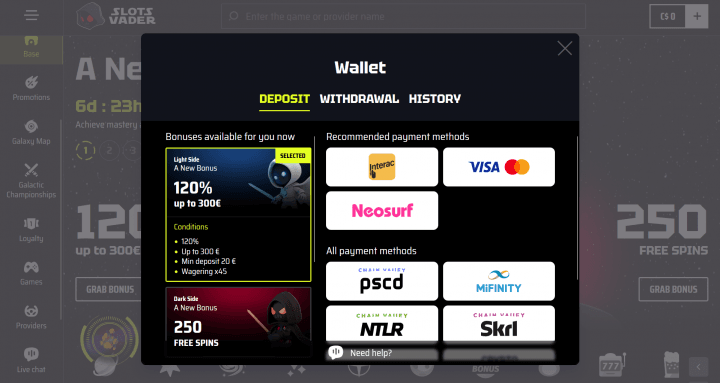
Slotsvader Casino gives you practical account management features that enable you establish daily, weekly, or monthly deposit caps. These limits function as a pre-commitment device, a hard stop you set during a calm, clear-headed moment rather than in the heat of a session. Setting a deposit limit isn’t admitting you have a problem. It’s a forward-thinking move, the same kind of budgeting you’d use to any other corner of your life. Once you meet that limit, the platform stops further deposits for the period you picked, handing you a forced pause to step back and reassess. Set limits that reflect your actual disposable entertainment budget, not the total funds sitting in your account. The most effective limits tend to feel a little conservative when you set them in a rational frame of mind, precisely because they account for the optimism bias that can take over once the reels start spinning.
Monetary Warning Signs to Watch For
Money management sits at the center of any responsible gambling strategy. One of the most evident financial red flags is chasing losses, when you fire off another deposit right after a losing session, trying to claw back what you just spent. That move nearly always pushes you past whatever limit you had in mind and can put a monthly budget off balance in a single evening. Other warning signs merit the same honest look: borrowing money to gamble, tapping into funds set aside for rent or utilities, or experiencing that knot in your stomach when you check your bank balance after a session. A healthy approach treats every deposit as the price of a night out, no different from buying concert tickets or a nice dinner. When the financial footprint of your gaming becomes hidden, when you find yourself covering up transactions from family or skipping your own account statements, the risk level has very likely crept beyond the safe zone.
Psychological Triggers and Mental Risk Factors
Gambling rarely happens in an emotional vacuum, and recognizing those connections is a crucial piece of any truthful risk assessment. Ask yourself whether you tend to open Slotsvader Casino when you’re feeling unoccupied, solitary, pressured, or worried. Using gaming as a constant escape hatch from negative emotions can build a dependency where the platform shifts from a source of fun into a coping mechanism. Feeling genuinely irritable or restless when you can’t play is another considerable psychological warning sign. The emotional arc of a session is important too: if a win sets off an nearly frantic urge to keep going, and a loss triggers deep frustration or an immediate compulsion to deposit again, your emotional relationship with gambling has turned unstable. A balanced player takes both wins and losses as part of the deal and can close the laptop feeling impartial, not exhausted or hopeless.
Time-Based Session Limits and Reality Check Notifications
Alongside financial controls, time-based tools offer another layer of protection. A session time limit enables you to choose beforehand how long a single gaming session should last. When the clock strikes that mark, a notification shows, and you can either log out or make a conscious choice to extend. That interruption acts as a reality check, interrupting the immersive flow and forcing a deliberate decision instead of a mindless continuation. You can also adjust reality check pop-ups to appear at regular intervals during play, displaying the duration of the current session, the amount deposited so far, and the net result. These brief flashes of transparency push back the tendency to lose track of both time and money in a fast-moving digital environment. Players who utilize deposit limits and session time limits together create a safety framework that covers the two most common paths toward risky play.
Professional Support Resources for Portuguese Players
When your self-assessment uncovers patterns that appear bigger than what you can deal with alone, outside professional support becomes essential. Portugal has several specialized resources for people experiencing gambling-related harm. The Linha Vida helpline, operated by the Serviço de Intervenção nos Comportamentos Aditivos e nas Dependências (SICAD), provides free and confidential telephone support. On the international side, organizations like Gamblers Anonymous offer peer-led recovery programs, and GamCare provides online chat services and structured therapy referrals. Many of these resources also provide support to family members who are affected by a player’s gambling. Here are the key contact points on offer to Portuguese residents:
- SICAD helpline for direct counseling and referral to local treatment centers.
- Gamblers Anonymous meetings available in major Portuguese cities and online.
- GamCare digital support and forum for anonymous peer and professional support.
- Self-exclusion request forms available directly through the Slotsvader Casino account settings.
- Financial counseling services that help with debt management related to gambling.
Getting in touch with any of these resources is a sign of strength, not weakness. The professionals and peers on the other end of the line recognize the complexity of gambling behaviors and offer non-judgmental pathways toward stability. Integrating platform tools like self-exclusion with external therapeutic support creates a recovery environment that addresses both the immediate access to gaming and the underlying behavioral patterns driving it.
Voluntary Exclusion and Cooling-Off Periods
Sometimes a short pause isn’t adequate, and admitting it takes sincerity. Slotsvader Casino features self-exclusion alternatives that stretch from multiple months all the way to permanent account closure. A cooling-off interval, typically spanning from 24 hours to six weeks, gives you a quicker rest when you need time to restore balance without agreeing to a long-term lockout. During a self-exclusion duration, your account gets locked, marketing communications cease, and you may not use the platform. This measure holds the greatest significance for individuals who have endeavored to moderate their play through limits but keep finding themselves ignoring or pushing those boundaries. Requesting a self-exclusion is a major decision, and a bold one. It shows a real commitment to your own well-being. The method is uncomplicated, and the customer support team processes these requests with respect and full discretion.
Time Commitment and Behavior Habits
The time you allocate on a casino platform often tell a story that bank records miss. A valuable self-assessment raises whether your sessions keep stretching longer than you planned and whether exiting at your scheduled stop time appears genuinely hard. Another question that strikes a nerve: is gaming commencing to encroach on your work, your relationships, or your sleep? When you notice yourself skipping social plans, blowing off professional obligations, or frequently trading sleep for screen time, the activity has ended being a leisure pursuit. It has become a priority that interferes with the rest of your life. Keeping a minimal log of session lengths over two weeks gives you an objective look at where the time actually goes. Patterns like late-night sessions carrying into early morning, or a gradual inability to enjoy other hobbies without your mind straying to the next deposit, are powerful behavioral signals. They deserve your attention.
FAQ
In what way can a player accurately assess their own gambling risk level?
A player is able to measure risk by recording three key areas over a two-week period: total deposits versus initial budget intentions, total hours spent gaming versus planned session lengths, and emotional responses after both wins and losses. Recording this data down creates an objective record that bypasses memory bias. If deposits consistently exceed planned amounts or if gaming sessions regularly run twice as long as intended, the risk level warrants attention and possibly requires tighter limits or a cooling-off period.
What’s the difference between a cooling-off period and full self-exclusion?
A cooling-off period is a short-term break, commonly lasting from one day to six weeks, during which the account is temporarily inaccessible. It is intended for players who need a brief pause to regain control. Full self-exclusion is a longer-term commitment, generally starting at six months and extending up to permanent closure. During self-exclusion, the account remains locked, and the player cannot reopen it until the chosen period expires and a formal reactivation request is processed.
Are deposit limits be adjusted immediately after setting them?
No, responsible gambling tools feature a delay mechanism to avoid impulsive changes. When a player wants to raise or remove a deposit limit, a cooling-off period of at least 24 hours is commonly implemented before the change takes effect. This delay ensures that the decision to raise a limit is made during a calm, reflective state rather than in the middle of a gaming session when emotions might override rational judgment. Decreasing a limit usually takes effect instantly.
Where might a Portuguese player find free and confidential gambling support?
A Portuguese player can reach the SICAD helpline, which provides free, confidential counseling and can direct individuals to local treatment services across Portugal. Additionally, Gamblers Anonymous organizes meetings in several Portuguese cities and offers online sessions that maintain complete anonymity. GamCare’s online chat service is also available internationally, offering 24-hour support in English with translation tools accessible for Portuguese speakers who need immediate assistance.
Can using responsible gambling tools influence a player’s account standing or bonuses?
Employing responsible gambling tools like deposit limits, session reminders, and self-exclusion does not negatively impact a player’s account standing, loyalty points, or eligibility for future promotions. These features form part of the platform as neutral safety mechanisms. Any active bonuses with wagering requirements that remain unfulfilled at the time of a self-exclusion request are generally forfeited according to standard terms, but the player’s right to use protective tools is not penalized nor restricted.